
the phoenix lens ©
an integrative framework for understanding embodied human experience.

the phoenix lens © is an integrative, trauma-informed framework for understanding distress, adaptation, and healing through the body, the nervous system, and the environments we live within.
it was created in response to the limits of dominant models that prioritize pathology, symptom reduction, and individual responsibility—often at the expense of context, meaning, and lived experience.
the phoenix lens © does not ask what is wrong with you? rather, it asks questions like what has happened, what patterns have formed, and what adaptive purpose do they serve?
the phoenix lens © emerged because i couldn’t find a framework that held the full complexity of human experience with care.
i saw mind–body science stripped of meaning.
i saw systems that treated people as problems, offering bandaid solutions while neglecting research that supports the mind–body connection
i saw distress individualized and pathologized while context, trauma, and power were left unexamined.
the phoenix lens © is my attempt to hold complexity without flattening it.
what the phoenix lens © is
the phoenix lens © is a way of seeing.
it is not a diagnostic model, a treatment protocol, or a replacement for professional care. instead, it offers a coherent lens through which symptoms, illness, behaviours, addictions, and patterns can be understood as intelligible survival responses shaped by lived experience.
the framework integrates:
nervous system and trauma science
embodiment and stress physiology
social, relational, and environmental context
meaning, identity, and agency
rather than isolating symptoms, the phoenix lens © considers how bodies adapt within specific conditions—and what is required for those adaptations to soften.
the structure of the phoenix lens ©
the phoenix lens © is organized into five interrelated domains. these are not stages to complete, but perspectives that inform understanding.
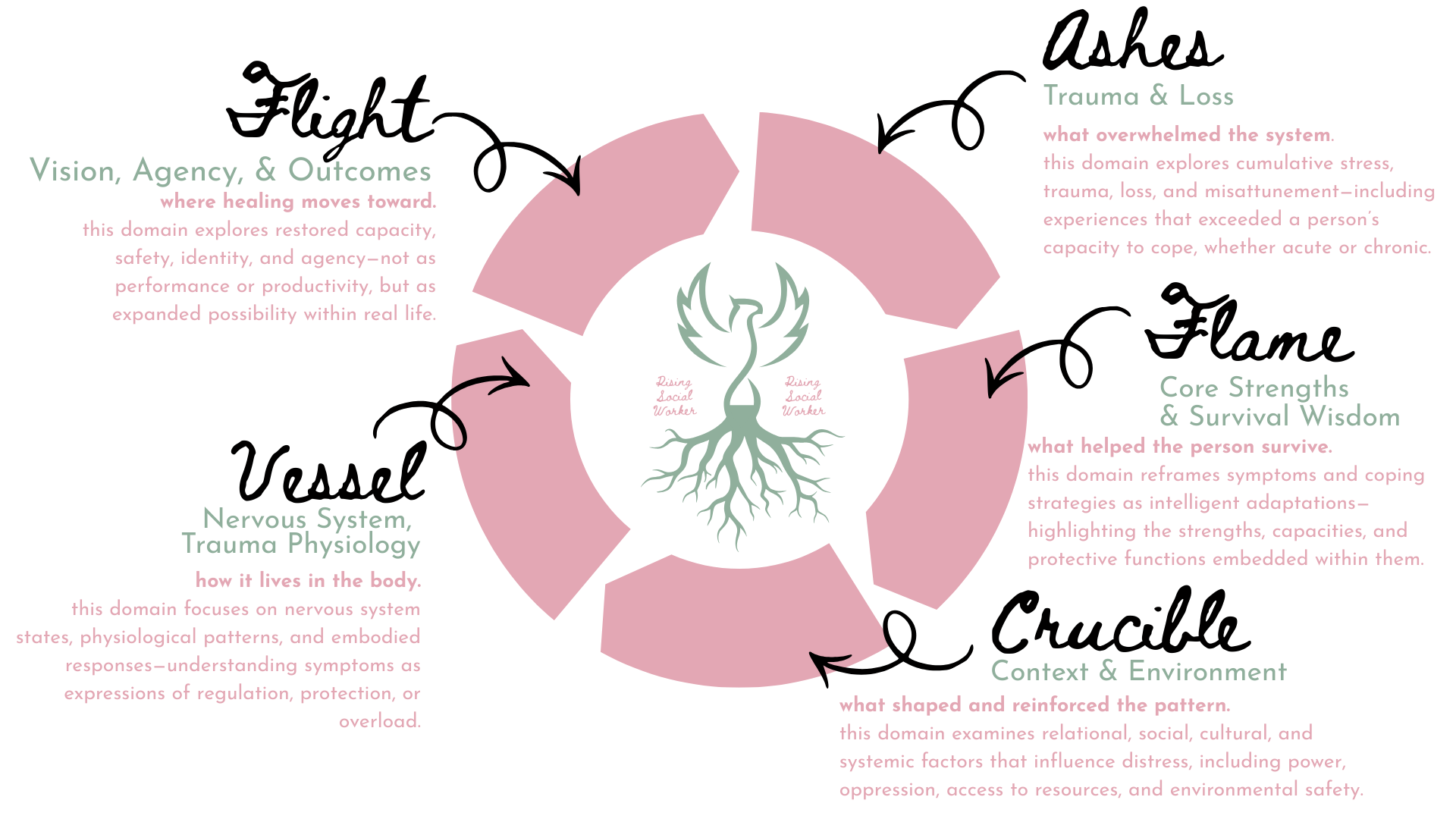
the questions the phoenix lens © asks
the phoenix lens © asks different questions.
instead of what’s wrong with you? it asks questions like:
what happened, and what did your body have to do to survive?
what is adaptive about this response, given the context?
what does this pattern protect, regulate, or preserve?
what conditions would allow this body to feel safe enough to change?
what does restoration look like—not in theory, but in lived reality?
these questions shift care away from pathologization and individual deficit, and toward context, meaning, understanding, and genuine healing.
who the phoenix lens © is for
the phoenix lens © may resonate with:
practitioners and helping professionals working with trauma, chronic stress, addictions, disease, and/or complex presentations
individuals seeking coherence around persistent symptoms or patterns
educators, supervisors, and students questioning reductionist and/or biomedical frameworks
systems thinkers concerned with ethical practice, power, and harm reduction
anyone seeking more humane ways of understanding distress and healing
it has relevance across healthcare, mental health, social services, education, community work, and personal reflection.
what the phoenix lens © is not
the phoenix lens © is not:
a quick fix
a one-size-fits-all model
a replacement for medical or clinical care
it is a reflective, integrative lens that supports ethical humility and contextual understanding.
what’s unfolding …
the phoenix lens © is continuing to take shape.
alongside ongoing writing and education, i am currently available for speaking, training, and consultation with organizations, teams, and learning spaces interested in trauma-informed, mind–body, and systems-aware approaches to health and healing.
an official phoenix lens guidebook and self-paced course are also in development, with a planned release in late 2026. these resources will support both practitioners and individuals in engaging the framework with depth, reflection, and practical clarity.
for now, this page offers an introduction to the lens and its underlying orientation—and an invitation to explore how it may be applied in real-world contexts.